Showing posts with label Data. Show all posts

Thursday, 5 December 2024

Fundamentals of AI in Education

I’m so excited to have completed the Fundamentals of AI in Education (Micro-credential) course with Craig Hansen and to be one of the first certified AI educators in New Zealand! 

The course was an inspiring experience, packed with practical strategies and real-world ideas for using AI in the classroom and beyond. I learned so much about integrating AI into lesson planning, assessment, personalising learning for students and addressing the ethical questions that come with these tools. I’m already putting this knowledge to work by using AI to boost student engagement, provide targeted feedback, analyse data and choose the best approaches for specific learning needs. 

The possibilities and practical applications are endless! 


Wednesday, 6 December 2023

End-of-Year Progress Data for My Year 3-4 Class: Maths, Reading and Writing

In this blog post, I'd like to share the end-of-year data for my Year 3-4 class. 

All results have been filtered to include only the 'same students,' ensuring a direct 'apples-to-apples' comparison of progress.

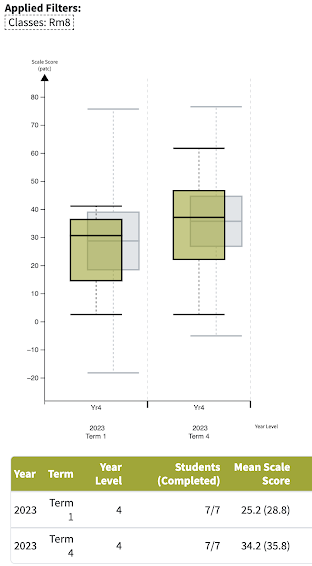
1. Mathematics Term 1- 4 PAT data

2. Reading comprehension Term 1- 4 PAT data

Year 4 (same students only) achieved a gain of 9 units, (=1.3 years of progress)

. 3. Writing Term 1- 4 OTJ (supported by e-asttle) 

Thursday, 16 November 2023

Improving Teacher Practice and Accelerating Student Learning in Mathematics (TAI 2023 presentation at Burst & Bubbles)

Since 2021, my inquiry focus has been on improving teacher practice and raising student achievement  in Mathematics. Over the past years, the Maths achievement data has been consistently concerning across many Manaiakalani schools at all year levels. Furthermore, the issue of students underperforming in math has captured national attention.

At the start of the year, I discovered that almost 90% of our new Y3 students were working below and well below their expected levels in mathematics. Their Term 1 PAT results confirmed the data I collected during other summative and formative assessments. This group of students became my target group, or I prefer to call them my control group, as I always strive to deliver the best teaching to all students. 

After analysing the school-wide T1 PAT results, I engaged in several professional conversations with my school leaders and teachers. We decided to adopt a more data-informed approach and redesigned and restructured our maths programmes across all year levels. We ensured a well-rounded focus on both Number and Strand, employing an integrated curriculum and fostering student agency.

I’ve been actively involved in supporting my school and other COL teachers by working on understanding various assessments, analyzing and using data for more effective planning. 

I've supported a number of teachers and teams by discussing and collaboratively reviewing their maths programmes, by selecting the best resources for teaching different concepts, compiling and sharing practical resources, for example, maths-integrated Matariki resources for L1 to 4 of the curriculum, by observing lessons, providing feedback, unpacking it and planning next steps. 

To share my expertise and passion for this subject, I provided in-class support by both modeling and co-teaching maths lessons.

This year, I’ve had the privilege of working as part of the Maths design group, with the goal of launching a new maths PLD program next year. I've already volunteered to pilot this program in Term 1. I really hope that this new Manaiakalani initiative will support our teachers in growing their capability and love for teaching mathematics.

To conclude my presentation, I’d like to share the end-of-year Maths PAT results of my targeted Year 3 cohort (Y3 learners in my class achieved 18.6 gain).  We filtered the data analysis by "same students only" to compare apples to apples. The group achieved a gain of 17 points, compared to the national average of 9.2. This difference translates to nearly 2 years of progress and means that, with my team, we successfully accelerated their learning in Mathematics.


Thursday, 28 September 2023

Monitoring the Effects: Term 3 e-asTTle Comparison Reports (Maths)

In this post, I'd like to share two e-asTTle comparison reports based on the latest assessment conducted in September by my Year 3 and 4 students. I have nine Year 4 students in my class but only two of them didn't sit this test due to their overall learning difficulties (they focus on their IEP goals). There is no e-asttle data available for Year 3 students from other schools.

Using the concept of repeated measures, I've been tracking my students' progress in maths and sharing their results with both them and their whanau. We looked at their individual reports to set up new goals and to see how far they've come and how much they've grown. It was a great opportunity for my learners to talk about their successes and next steps during our end of Term 3 Tamariki Korero. 

Report #1.  How are my students doing compared to students in ALL other NZ schools?

Report #2.  How are my students doing compared to students in SIMILAR schools (low decile)?

E-asTTle offers a range of individual and group reports that I've been using as formative and summative assessments to guide my students toward their learning success. Along with other assessments, I use e-asttle to keep a close eye on student progress and needs and to make teaching adjustments as needed. 

Next year, I will administer the same test at the beginning of Term 1 and then each term to collect data for e-asTTle progress reports and to compare them with PAT results (out of my personal curiosity).

Thursday, 27 April 2023

Food for Thought or Just One PAT Question Analysed

After publishing my post about PATs areas that we test on without teaching, I recalled and decided to share a story about my last year Y4 student who scored Stanine 9 in PAT but struggled with one particular question - "Visualise which shape a net will fold to make." 

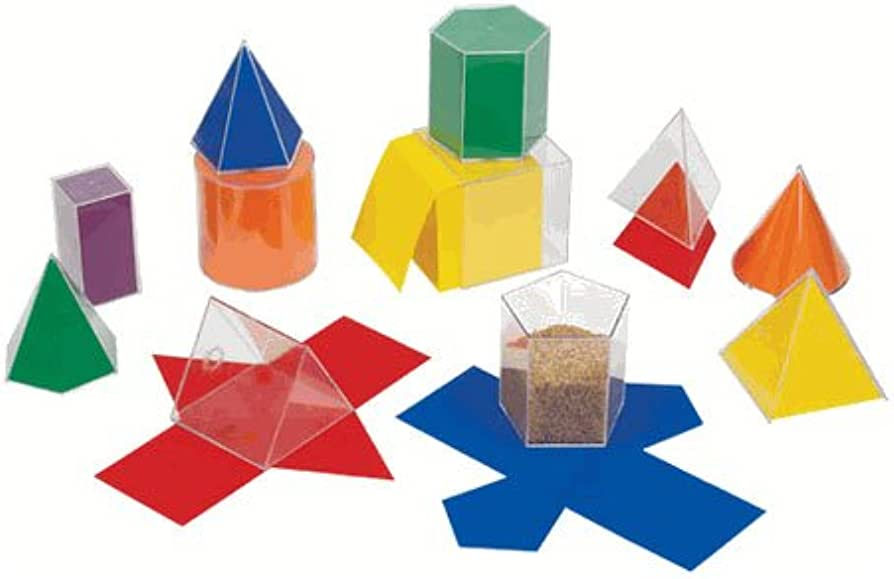
At that time, I was placing an order to buy more maths resources for our school including a set of 3D folding shapes, which we used with our Year 3-4 classes. I wanted to provide our students with a hands-on way to explore and visualize 3D shapes and their nets. Little did I know that this tool would have a significant impact on their learning, even a year after using it. Surely, you can fold 3D shapes using paper, but we had an opportunity to purchase this maths equipment and students loved it!

Out of curiosity, I looked at random Y4 and Y5 classes to find out their answers to this particular PAT question for the past 3 years.

2020 - Term 4


2021 - Term 4

2022 - Term 1

2022 - Term 4 -  our Team excelled in the PAT "visualise a shape" question that had previously stumped many of Year 4 and 5 students.

2023 Term 1 (after the summer break, mostly the same students with some new intakes)

"Visualize which shape a net will fold to make." This question could be challenging for some students because of a specific skill we often do not cover in our maths programme. 

As seen from the examples above, after using the folding shapes in our team, students were able to visualize the 3D shapes and their nets with ease. They were able to apply their knowledge to the PAT assessment and, in Term 4 2022 for the first time in three years, most of Team Kea's students answered the question correctly. Furthermore, the majority of learners retained their knowledge after a summer break (this is not clean data as we have a number of new students from other schools and teams).

This set of data highlights the importance of analyzing assessment data to identify areas where our students need explicit teaching or additional support. 


Wednesday, 26 April 2023

Tools, Measures & Approaches

Describe the tools/measures/approaches you plan to use to get a more detailed and accurate profile of students’ learning in relation to that challenge. Justify why you chose these approaches and tools.

Recently, I had the opportunity to analyze PAT assessments from our school and discovered some concerning learning gaps among our students. Many students struggled with questions that were not covered in our classroom maths programmes or were only briefly covered (based on my personal, team and other teachers' reflections)

If students have never been exposed to specific maths concepts or skills, expecting them to answer questions on those topics is not fair. In fact, testing students on material they have not been taught is not only unfair, but it is also not an accurate reflection of their true understanding of the maths curriculum.

The PAT exams are designed to assess a student's understanding of the broader maths curriculum, but this does not mean that students should be expected to answer questions on topics not taught in class. 

I used the 'individual items' report for all our classes and identified similarities in topics that most students struggled with: Statistics, Geometry, Measurements, Fractions and Algebra. Some examples are below:

                                                                    Year 5:                                                                          


Year 8:
Year 4:

On the other hand, I also analysed which areas of Maths we delivered effectively. This is just a great illustration of "what we taught - our students learnt!" We just need to review our maths programme and include the areas that we neglected before.

                                                                     Year 4:                                                                            

Year 5

A hypothesis I developed was that our current maths programme was not adequately covering all the topics included in the PAT assessments. To create a rich picture with a high degree of reliability and specificity, I plan to create an e-asttle test including all the areas tested in PATs. Gloss data also will be used to support Number knowledge and strategies results. 

Along with these 3 tests, I will collect student voice. I already interviewed a few students after their PATs and discovered that many of them experienced frustration due to their lack of knowledge on certain topics. Formative assessment is ongoing.

At the same time, we need to ensure that we're not simply teaching to the test. Our goal should be to provide our students with a well-rounded understanding of the subject. This means incorporating a variety of teaching strategies, including hands-on activities, real-world applications and opportunities for critical thinking and problem-solving. Teaching Measurements, Geometry and Statistics can be part of the integrated curriculum - our LCS pedagogy. 

I shared my findings with my school's teachers and senior team. My purpose was to highlight the importance of using assessment data for planning. 

I will continue with my inquiry about helping teachers understand the value of using assessment data effectively to create a culture of data-driven instruction in my school and hopefully the wider Manaiakalani Kāhui Ako.  I truly believe that this can lead to improved student outcomes and a more effective and meaningful learning experience for both teachers and students.

Wednesday, 22 March 2023

Refining my TAI (What, How, Why) - Focus on Design and Assessment for Learning

1. Design for Learning in mathematics involves creating a comprehensive plan or roadmap for teaching and learning mathematics. This design should consider the specific needs of the students and align with the NZC. 

I believe that mapping an effective maths program should include clear learning objectives, a scope and sequence, lesson plans and resources, PLDs for teachers, and monitoring student progress using formative and summative assessments.

2. Assessment for learning (AfL) is a critical aspect of teaching mathematics in primary schools. It involves a process of ongoing evaluation and feedback to help students understand:

  • what they have learnt, 
  • what they need to improve
  • how to achieve their learning goals. 

In the context of mathematics, AfL is particularly important because it allows teachers to identify areas where students are struggling and tailor their teaching to meet individual needs.

I discussed my 2023 inquiry focus with a number of leaders and teachers at my school and was impressed by their responses. I'm ready to embark on a new challenge and thrilled to be doing so with the GTS collaborative team.


Evidence of Improving Teacher practice and Student achievement in Mathematics in GTS

In 2021 I analysed our school data in Maths and raised my concerns with the management. I was thrilled that my voice was heard! This initiative led to a school-wide collaborative inquiry into improving the teaching of mathematics. Last year, we took this inquiry to the next level. After reviewing school Maths Matrices, we focused on two powerful areas: teacher practice and student agency. That meant that we needed to give students both the option to make choices to direct their own learning and the information they needed to make strong choices. Interestingly enough, after unpacking Maths matrices with their students, our teachers began to use these Matrices for their planning. 

Thanks to Johanna's (DP at GTS) data analysis before and after this intervention, we can provide clear evidence of the positive impact of this collaborative approach. 


In her recent Staff presentation, Johanna shared: "The impact of AfL is obvious when you look back on historic ‘normal’ year which is on the left - numbers stayed this same in WB, B, At & Above and compare it to this year on the right where there is a definite shift due to the focus on Assessment for Learning.  Teachers have noticed a difference and students are more engaged.  We still need a lot of work in maths and this will continue in 2023"

I totally agree that collaborative efforts between teachers, school leaders, and students have a significant impact on improving teaching practices and student learning outcomes. 

Wednesday, 15 March 2023

My 2023 TAI - focus on Mathematics!

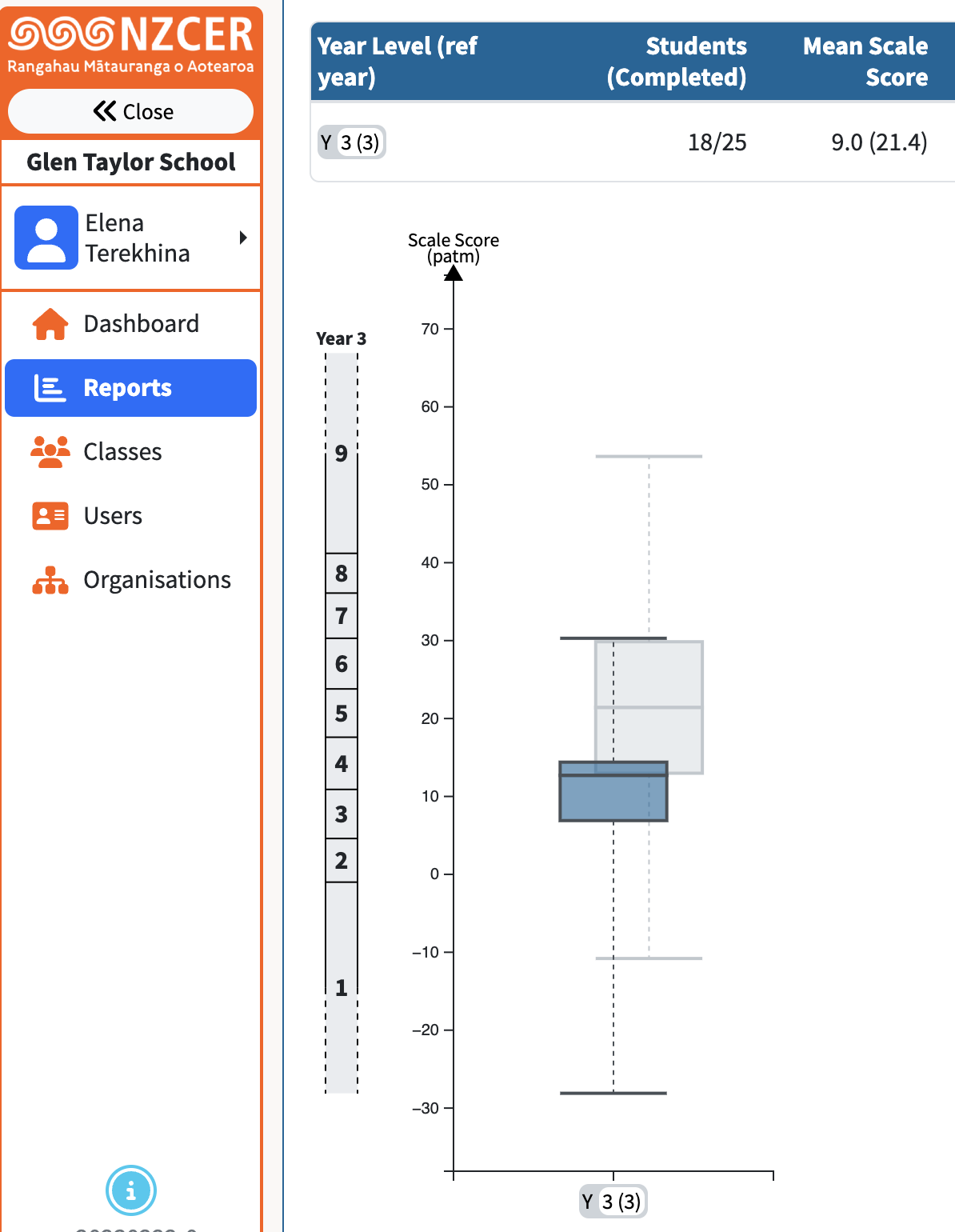
Thinking of my 2023 inquiry focus. I observed my team’s new Y3 students and discovered that about 90% of this cohort is working below and well below their expected levels in mathematics. Their PATs confirmed the data I collected during formative assessments. I believe that this is a result of previous years of disrupted learning.  The current Y3 students missed out on timely development of very crucial fundamental skills and knowledge as young students were very hard to reach and keep engaged during lockdowns and hybrid learning. When they returned to school, the main focus was on developing positive attitudes towards school and love of learning. 


PAT Y3 2023 Term 1 data


Monday, 22 August 2022

Monitoring the Effects of Teacher Collaboration in my Team on Learner Outcomes

Identify informal and formal ways you are monitoring the effects of your changed practices/intervention on learner outcomes. Explain the reflections and tweaks you are making along the way.

My Inquiry: Will Teacher Collaboration improve student engagement and raise their achievement?

In my team, we reflected on our collaboration and mid-year results. Have we managed to lift our students' engagement and achievement due to the change we've implemented in our planning? The short answer is yes; however, we also developed a shared understanding of our next steps: bring student agency on board and refine our planning.

Since the beginning of my inquiry, we have developed a habit of ongoing reflections on our practice. It now happens naturally, almost every day when we share what worked well and what needs to be improved. We act faster and are not afraid to give feedback about each others' work. I believe that our professionalism helped us develop a healthy collaborative partnership in our team.

Some tweaks that we did since the beginning of my TAI:
- introduced and unpacked maths matrixes with our learners. This allowed them to take ownership of their independent learning choices. 
- our next step was to provide our students with choices to support their independent meaningful learning. As a result, we designed our maths and literacy choice boards that our students love to use.
- redesigning our planning template to make it easy to use by all stakeholders: team members and our learners. We all now know what to do and when. 

Monitoring the effect: 
- Many of our students developed self-motivation. Many ask for maths homework as they want to improve their results. 
- I let students choose to join different groups to deepen their understanding of current topics (maths) and many of them love having more freedom in their learning. 
- Students across all 3 classes are getting the same consistent programme and are less dependent on individual teachers' knowledge of maths.
- My team appreciates our collaborative approach as it helped them improve their own knowledge of the curriculum. We also bounce ideas from each other, taking and implementing the best of them.
- mid-year Data showed progress and some acceleration in our students' achievements across the syndicate. 


Tuesday, 10 May 2022

Tools, measures & approaches to measure students progress

Describe the tools/measures/approaches you plan to use to get a more detailed and accurate profile of students’ learning in relation to that challenge. Justify why you chose these approaches and tools.

To measure my students' progress and knowledge, I plan to use both formative and summative assessments with a bigger emphasis on formative assessment strategies. I believe this will help improve teaching and learning simultaneously. 

Three types of standardized maths tests:

PAT, GLOSS/JAM and e-asttle

Surely, along with the standardized tests, I'll be using formative assessments (observations, student voice, conferencing, number talk and problem solving - tasks that require students to use skills or apply ideas, etc) to evaluate my students' progress.

The first set of Term 1 data showed that over half of my team's learners are working below or well-below expectations in Maths. Last year, my class' progress proved that my maths programme worked well for my students. This year, with the focus on team collaboration, I hope to extend my inquiry across my syndicate.

Wednesday, 15 December 2021

Burst in Bubbles 2021 - TAI 2021 Evaluation (Maths focus) - #23

Kia Ora, my 2021 inquiry started after collecting my first set of data, when I discovered that 61% of my learners were working well below their expected levels in Mathematics. 

During the profiling phase, I used student voice, formative and summative assessments, and referred to their historical data that revealed a widening gap in their achievements over the past years at school. Sadly, many of these students didn’t believe they could be good at Maths, some said that Maths was too hard for them. Interestingly enough, the same students enjoyed much better results in reading and writing.
So I decided to dig deeper into High leverage practices in mathematics to try to accelerate their learning.
We started by co-constructing positive norms, using Talk Moves and having ongoing conversations about the growth mindset. Soon,  most of my students began to feel more comfortable doing Maths.

During the planning stage of my inquiry, I looked at international results in maths and referred to research and practice of the most successful countries. I questioned myself, about what they’ve been doing differently from New Zealand and from our school.

I identified many differences but focused on the most crucial findings:
  • They use well-designed maths programmes supported by textbooks or digital platforms, not depending on individual teachers’ planning
  • They value explicit teaching, use of materials and deliberate practice in order to develop student’s ability to transfer their knowledge and skills
  • They often revisit topics to build long-term memory and deepen understanding.
Reflecting on these, I restructured my maths programme to accommodate these best practices. For example, I now allow more time for deliberate practice with a gradual release of responsibilities. Another important skill that I’ve been explicitly teaching and practising with my learners is ‘translating’ word problems into maths equations. This definitely helped to improve their comprehension, critical thinking and problem-solving skills. The mid-year data showed some good progress of my learners and I’m now in the process of collecting term 4 data.

I also extended my inquiry across our school. Supported by the management, we had a staff meeting with a focus on maths data, content knowledge, progressions and understanding of assessments. We planned to have a school GLOSS and JAM moderation. Collectively, we reviewed school expectations for planning, use of resources and delivery of mathematics. I tried to support my colleagues by sharing my practice via class on-air and on my blog, by modelling maths lessons, helping with planning and resources and pedagogy behind them. At the beginning of the last lockdown, I curated and shared a collection of digital tools for online learning. 

I believe that the changes that I made this year in my own practice and initiated school-wide will have a great impact on our teachers and learners raising their confidence, engagement and achievements in maths. 

Due to Level 3 in Auckland, the Bursts and Bubbles were conducted online. Below is the video I recorded about my inquiry this year and how I have improved my own practice and supported my colleagues. This year wasn't a usual face-to-face teaching year but there was still some great data and evidence that came out of my inquiry.


Wednesday, 17 November 2021

Year 4 Maths PAT data - repeated measures - TAI #22

Yesterday, I administered a Year 4 Maths PAT. We started by talking about integrity when doing the test online. The cameras were on all the time with no creative backgrounds and no other people around them. We also had a conversation about how teachers use the test information in their planning. Practice makes perfect - that was our purpose for this test. I used filters to compare the results of the students who participated in Term 1 and Term 4 tests (comparing 'apples to apples'). 

I'm very proud of my students who have shown resilience, great engagement and love of learning during these lockdown times and kept improving their knowledge and skills despite the circumstances!


Thursday, 12 August 2021

Collaborative Sense Making #15

In considering the collected data, both quantitative and qualitative and the conversations that I had with the school management,  I became confident that I had enough information to support other teachers in my school with their maths programmes.


Reflected on the data and our needs, we decided that Maths requires our urgent attention.  I was really excited to see the openness of my colleagues to learn, try new things and improve practice.


Now it's time to act!

Friday, 2 July 2021

Repeated measures - Beginning and Mid-year Data #12

My focus was on unpacking and front-loading math vocab and the use of material/ visuals to improve my students’ mathematical thinking and deeper understanding of effective strategies.

We've been working on implementing and improving our class mathematical conversations and understanding of basic mathematical terminology.  Number talk and choral counting have been powerful practical tools that supported my students' mathematical reasoning along with the importance of being able to listen to others, understand the language and vocabulary, and be able to participate in a meaningful conversation about math. 

My second focus was the importance of using materials to support children’s mathematical thinking, reasoning and problem-solving. I tried to carefully select appropriate tools and representations to provide support and develop their number fluency and a deeper understanding of strategies.

The following group of students had historical data falling behind their expected levels and performing at well-below levels. With the focus on mathematical discourse and using manipulatives, they have shown great progress during this short period!

The repeated measures: GLOSS/ JAM/ Basic facts and class observations.


Friday, 28 May 2021

Professional reading for Hypothesis Generation - #7

My inquiry is targeting progress not only in mathematics;
however, my class and school data show a strong need to address this issue.
Why the majority of our students are underachieving in maths, what can be done differently? 

To help me generate a hypothesis about aspects of teaching that might contribute to current patterns of learning, I referred to a number of professional reading and had a conversation with a cognition maths facilitator Rebecca Bishop.

This video episode is one of the Developing Mathematical Inquiry Communities lessons that I keep referring to.

The pedagogy is consistent with the findings of best evidence syntheses. The lesson shows the main components of the structured maths programme: a teacher-directed Launch, moves into Group Work followed by each group Sharing Back with the whole class. 

I try to implement all of these elements in my class maths programme too and found that it is very difficult to have a whole-class launch or Number Talk with my class as I have learners at Stage 5 and Stage 1-2. So I have to split the class into groups during the explicit teacher teaching time. For problem-solving, I often use Low floor - High ceiling problems so my students could participate and develop their confidence and creativity in maths.


Friday, 21 May 2021

Three Measures to Evaluate Progress - #6

TAI WFRC: Discuss THREE measures you could use pre- and post- to compare students’ learning before and after your intervention. 

To measure my students' progress and knowledge, I plan to use both formative and summative assessments with a bigger emphasis on formative assessment strategies. I believe this will help improve teaching and learning simultaneously. I aim to actively encourage them to be cognitively engaged and take ownership of their learning.

Three types of standardized maths tests - assessments:
PAT
GLOSS/JAM
LPF

Surely, along with the standardized tests, I'll be using formative assessments (observations, student voice, conferencing, number talk and problem solving - tasks that require students to use skills or apply ideas, etc) to evaluate my students' progress.

Sunday, 25 April 2021

Hands Up if You Think that You Are a Good Mathematician... - #5

In my first Class OnAir episode, I asked my students to raise their hands up if they think that they are good mathematicians... only 3 hands went up. It showed me that the students didn't have a positive attitude towards maths and didn't believe in themselves.

I also collected student voice - disposition data and discovered that all of my underachieving students had rather negative beliefs about themselves as mathematicians. It was a strong signal to start building up their confidence by talking about Growth Mindset and implementing Talk Moves to support the positive norms in maths class.

I believe that the positive learning classroom culture goes beyond the ‘classroom treaty’ created in the first week of school. The positive norms in maths class needed to be constructed together so that students know what is expected of them and for them to have the tools to respond to and meet those expectations.


I want my students to work collaboratively and engage in mathematical discussions by sharing and explaining their thinking and reflecting on the thinking of others. To achieve this we have ongoing discussions around how we work together and what is important to become better mathematicians.

I believe that my students have now started to value productive struggle and they are now keen to participate in our Number Talks as they aren't afraid to take risks and make mistakes.

Wednesday, 21 April 2021

What, Why and How of my TAI 2021 - #4

WHAT aspect of my professional practice do I want to grow my capability in?

  • Balance of DATs, 
  • Talk Moves and Positive Norms for learning  - Class Treaty that is used throughout the year, not just a beginning of the year activity), 
  • Integrated curriculum - LCS projects as multiple opportunities to develop students' critical thinking skills and boost cognitive engagement.

WHY is this important to me and my School or Centre?

  • Targets set up in our School Charter
  • A strong need to accelerate our learners and improve student achievements
  • Student engagement to foster their love of learning

WHAT do I want to achieve for my learners? 

Create a learning environment where all learners are engaged in purposeful learning,  use their critical thinking skills, achieve well in all curriculum areas with a big focus on Maths and enjoy learning

How will I achieve my goals

  • Implement Talk Moves, Number Talk and Problem solving
  • Explicitly focus on developing a Growth mindset and changing their negative beliefs about 'being bad in maths'
  • Participate in COL and ALIM networks to improve our student engagement, critical thinking and achievement across the curriculum.
  • Continue to differentiate and plan for learning/ teaching using school Matrixes, WALTs and the NZC
  • Collaborate with my colleagues by presenting during the TOD and publishing my Class OnAir episodes to share and reflect on my practice and to seek feedback to improve it.

Saturday, 3 April 2021

Data Collection and Analysis - #3

Data reveals serious historical issues that require to be addressed. Data screams for urgent actions!


Over 60% of my class are operating at the well-below and below the expected levels in both Reading and Maths. I traced back some of my students' data and found that for the past 2-3 years they always were well-below or below without showing an acceleration in any of the preceding years. As I'm still to finalise my target group for my inquiry, I consider narrowing my focus down and planning my inquiry around shifting these students' achievements in maths. 


At this point of my inquiry, I feel a bit nervous but also excited as I have to come up with something different from their previous learning experiences, reflect on my own practice and extend my teaching approaches and tools to accelerate these historically underachieving students.