Friday, 23 February 2024

Insights from the initial MPI Pilot Sessions

I'm excited to share some snippets of the new Maths Practice Intensive (MPI) that we're piloting this term and that will be launched for the first cohort from term 2.

Day #1. We began by looking at the pillars of practice - the integral components of the effective maths programme. 

We also highlighted the importance of fostering a positive learning environment for maths, nurturing creativity and integrating cross-curricular opportunities for real-life application. Exploring the concept of teachers seeing themselves as mathematicians, we recognised that this perspective can lead to a transformative shift in our approach to designing our maths programmes and opening the door to a more dynamic and engaging teaching style. This shift can instil confidence in both teachers and students, promoting the belief that everyone has the potential to excel in maths.

Day #2. We explored a range of formal and informal assessments to fully understand the available tools and practical implementation of Assessment for Learning (AFL). We practised analysing PAT and e-asttle data and engaged in coaching conversations about how to use this data wisely. The emphasis on sharing assessment data with students and incorporating self-assessment tools in our teaching was also discussed. The program encourages us to reflect on how often we allow and prompt students to reflect on their learning and whether we are tapping into their self-driven learning potential (student empowerment).

Day #3 was all about practical aspects: long and short-term overviews, timetabling, flexible grouping, lesson planning, and organising for group discussions (group talk). It was great to give it a go and solve a 'low floor high ceiling' problem ourselves in breakout spaces, followed by sharing with the big group. This activity will be useful for teachers' learning as it encourages thinking about their own mathematical knowledge, ideas, gaps, next steps, and resources they might need for the lesson, etc. I loved that Fiona used Talk moves with us, letting us experience how our learners would feel and behave; "revoicing" definitely made me refocus on the group conversation. Another practical aspect of the programme is "gifting" well-designed and pre-planned task boards ready to be used in class. Finally, we shared some resources for independent activities that might enhance students' learning experiences and help develop fluency.

To conclude, I'd like to emphasise that every part of the programme is designed with robust evidence in mind and backed up by research. Throughout the programme, teachers will be referred to relevant readings to deepen their pedagogical knowledge and better understand why the offered approach is effective.


Tuesday, 20 February 2024

Calendar Booking Page

Kia Ora teachers!

I am excited to work with you this year. My COL days are Thursday and Friday. This Term, I am part of a new MPI (Maths Practice Intensive) pilot, working with a collaborative team every Thursday. I am available on Fridays this term. Please click and book any of the time slots available on my calendar booking page below:

Calendar Booking Page Link

I am happy to meet in person or online, or support your teaching in class. I would appreciate it if you let me know what support you are after following the booking, so I can come prepared and utilise our time effectively.

Please check this blog post for some ideas of how I can help you, but there are no limits. I look forward to getting connected with you and supporting our tamariki to thrive with their learning!


Monday, 12 February 2024

Across Schools COL Teacher 2024

 Kia Ora wonderful Manaiakalani educators

This year, I'm excited to continue collaborating with Kahui Ako teachers and sharing my knowledge and skills as an AS COL teacher. I'm particularly passionate about Maths and will be focusing on effective teaching practices in Mathematics across Y1–6. However, I am always happy to support teachers with all of their questions across the curriculum. I can offer:

  • Working with you on developing and implementing a balanced classroom programme 
  • Developing student agency/ student empowerment. I'm happy to explain the approach we developed at GTS and support implementing it with your class.
  • Designing engaging LCS projects (integrated curriculum)
  • Unpacking curriculum progressions across the curriculum 
  • Planning lessons or units
  • Understanding and using various assessments (formative and summative)
  • Analysing assessment data and using it for planning
  • Selecting the best resources to teach different concepts in Maths
  • Co-teaching, observing, feedback and modelling
  • Number Talk and the use of various manipulatives and digital tools in maths
  • Creating multi-modal sites 
  • Support with your movie for the Film Festival

I truly look forward to collaborating with you to create engaging learning opportunities for our tamariki and to help them achieve their full potential.

I'm available to work with teachers during their class and release time. This term, I am part of the MPI (Maths Programme Intensive) pilot program on Thursdays but available every Friday. 


Wednesday, 6 December 2023

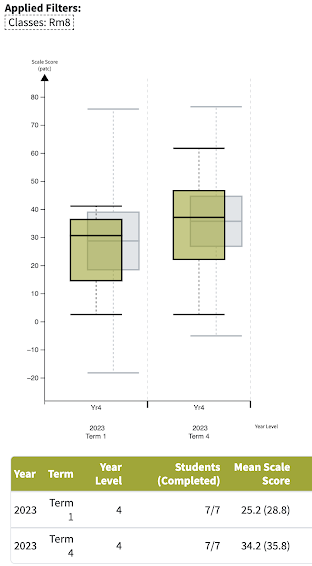
End-of-Year Progress Data for My Year 3-4 Class: Maths, Reading and Writing

In this blog post, I'd like to share the end-of-year data for my Year 3-4 class. 

All results have been filtered to include only the 'same students,' ensuring a direct 'apples-to-apples' comparison of progress.

1. Mathematics Term 1- 4 PAT data

2. Reading comprehension Term 1- 4 PAT data

Year 4 (same students only) achieved a gain of 9 units, (=1.3 years of progress)

. 3. Writing Term 1- 4 OTJ (supported by e-asttle) 

Thursday, 16 November 2023

Improving Teacher Practice and Accelerating Student Learning in Mathematics (TAI 2023 presentation at Burst & Bubbles)

Since 2021, my inquiry focus has been on improving teacher practice and raising student achievement  in Mathematics. Over the past years, the Maths achievement data has been consistently concerning across many Manaiakalani schools at all year levels. Furthermore, the issue of students underperforming in math has captured national attention.

At the start of the year, I discovered that almost 90% of our new Y3 students were working below and well below their expected levels in mathematics. Their Term 1 PAT results confirmed the data I collected during other summative and formative assessments. This group of students became my target group, or I prefer to call them my control group, as I always strive to deliver the best teaching to all students. 

After analysing the school-wide T1 PAT results, I engaged in several professional conversations with my school leaders and teachers. We decided to adopt a more data-informed approach and redesigned and restructured our maths programmes across all year levels. We ensured a well-rounded focus on both Number and Strand, employing an integrated curriculum and fostering student agency.

I’ve been actively involved in supporting my school and other COL teachers by working on understanding various assessments, analyzing and using data for more effective planning. 

I've supported a number of teachers and teams by discussing and collaboratively reviewing their maths programmes, by selecting the best resources for teaching different concepts, compiling and sharing practical resources, for example, maths-integrated Matariki resources for L1 to 4 of the curriculum, by observing lessons, providing feedback, unpacking it and planning next steps. 

To share my expertise and passion for this subject, I provided in-class support by both modeling and co-teaching maths lessons.

This year, I’ve had the privilege of working as part of the Maths design group, with the goal of launching a new maths PLD program next year. I've already volunteered to pilot this program in Term 1. I really hope that this new Manaiakalani initiative will support our teachers in growing their capability and love for teaching mathematics.

To conclude my presentation, I’d like to share the end-of-year Maths PAT results of my targeted Year 3 cohort (Y3 learners in my class achieved 18.6 gain).  We filtered the data analysis by "same students only" to compare apples to apples. The group achieved a gain of 17 points, compared to the national average of 9.2. This difference translates to nearly 2 years of progress and means that, with my team, we successfully accelerated their learning in Mathematics.


Sunday, 5 November 2023

AS COL support provided in 2023 (with a focus on Maths)

This year, I have been privileged to support and collaborate with the broader Manaikalani community to enhance teacher practice in Maths. This included working with individual teachers, teaching teams across Y1-8, COL colleagues, school and Kahui Ako leaders, and the Maths Design Group. I also provided support for our RTLB colleagues.

Here is a snapshot of my AS COL support:


Saturday, 21 October 2023

Team Feedback on Maths Programme and Team collaboration this year

This year, I've had the privilege of leading a team of five enthusiastic Y3-6 teachers. It has been an interesting and sometimes challenging experience with a lot of changes: we welcomed some new team members who felt more comfortable teaching literacy than maths. I heard them say, 'I am not a maths person,' multiple times. Furthermore, most of our team had to learn the curriculum for new year levels they hadn't taught before.

Thinking of the wisdom of the famous saying, "Tell me and I forget, teach me and I may remember, involve me and I learn," we involved our newbies in team planning. I believed that involvement and shared responsibility would be the keys to transforming their perception of teaching Math.

I have been always available to model, co-teach, observe, explain maths progressions and resources, help with assessments, etc. Two of my team members had never planned for Year 5-6 maths (Level 3). I supported them by initially planning for those stages at the beginning of the year, gradually passing these responsibilities to them as they developed more knowledge and confidence.

Throughout the year, I observed the need for a universal planning template. So, in Term 3, a new universal planning design emerged, simplifying the planning process and enhancing our teaching and providing consistent learning experiences across our classes. You can read about our planning here.

Last week, I collected feedback from my team, seeking their insights and perspectives on our collaboration, teacher capabilities in maths and areas for improvement as we always strive to provide the best for our learners. Some findings are below:

Did collaborative planning help you deepen your knowledge of the maths curriculum and better understand progressions (stages)?

Teacher #1: Yes- I think the strength comes from different perspectives and how everyone approached the planning of the math curriculum. Elena led the team effectively, ensuring each member knew which progression they were planning while always providing support. This helped us grow stronger in planning, understanding the Maths curriculum and progressions, and how to teach Maths effectively.

Teacher #2: Yes, with having to plan all different stages it deepened my knowledge of the progressions as well as the maths curriculum. I was able to look at what my team had planned which allowed me to have access to more resources. As I had come from teaching year 3 & 4 I had never planned stage 6-7 before which at the beginning of the year I found challenging. With Elena's support and using my team's planning, I was able to gain a deeper understanding of what these stages looked like for all different strands etc.

Teacher #3: I think for me personally (as a fairly inexperienced maths teacher), planning my own lessons has allowed me to deepen my understanding of individual stages one at a time. If I was to have planned for all stages at the same time, I would have likely become overwhelmed. I now feel more successful and confident in teaching maths.

Did team planning help you feel more comfortable and confident when teaching maths?

Teacher #1: Yes! I love that I can bounce ideas off from my colleagues and that I can ask for advice in a safe space. 

Teacher #2: I love the evolution of how the planning templates have developed. Elena was mindful to support her team (most of whom were relatively new to teaching) and as such the planning templates helped to scaffold understanding of concepts and delivery. Even for someone with experience like me, I found them so useful! 

Teacher #3: Absolutely. Now I feel so much more confident teaching maths, I really enjoy working with Elena, Team Kea and using our planning format.

Teacher #4:  Yes, it was great to use the same structured format and also have others' planning as an example when completing my own planning. 

What do you like about our collaborative maths planning and the changes that we made this year?

Teacher #1: As a newbie! I love it, it made planning ahead so much easier and you can find planning and tailor it to suit the needs of our kids. 

Teacher #2: At the beginning, when we started teaching from each other's plans, I found that different teachers’ plans varied to some extent and I found different planning layouts confusing. However after Elena suggested the new planning format and explained it to us, I better understood how to plan for a good maths programme. I loved our Term 4 strand planning idea, I found it extremely helpful having the resource bank of plans that we can use and to slot it into our own classroom programs when needed. 

Teacher #3: I love to plan on the slides, it’s interactive and it is visually appealing. It was great to have  same expectations across classes and maths stages. We also often reflect back on what worked well and what didn’t, which helps improve our maths planning and teaching (since we learn from our mistakes).

Teacher #4: I felt like the pressure of planning was reduced by a significant amount. I wasn't spending all weekend finding/ creating resources and lesson plans. Now with our planning, we are able to put more thought into our lessons and explicitly teach. I find that our learners are getting more out of each lesson and the design is easy for them and the teacher to follow. When I had my student teacher in class, she commented on how easy she found our template and how she found it easy to follow other teachers' planning. 

As a team, we also reflected on the implementation of Maths Matrices to empower our students. 
All of us witnessed the positive impact they've had on empowering our students and engaging our students' whanau. This experience has reinforced our commitment to continue using Maths Matrices next year and beyond.